

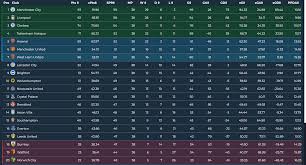
Result consistency in the Premier League is less about occasional winning streaks and more about how rarely a team deviates from its performance level across a long schedule. Identifying the clubs with the most stable outputs reveals how squad quality, tactics and psychology combine to produce predictable points returns rather than boom‑and‑bust campaigns.
What “consistency of results” really means in this league
Consistency can be measured by how seldom a team loses, how long its unbeaten stretches last and how small its swings are between strong and weak periods. Arsenal and Liverpool, for instance, each lost only four times in the 2024/25 season, giving them the fewest defeats in the division and a very narrow band of negative outcomes over 38 games.
Unbeaten‑run metrics sharpen the concept. Manchester City produced a 32‑match unbeaten streak spanning the end of 2023/24 and the start of 2024/25, while Arsenal’s historical 49‑game run remains the benchmark for result stability; these long sequences reflect not just talent but the capacity to avoid prolonged dips even when performances fluctuate slightly week to week.
Which recent Premier League teams show the highest consistency?
Recent seasons highlight a recurring group near the top of consistency rankings: Arsenal, Liverpool and Manchester City. In 2024/25, Arsenal and Liverpool tied for fewest losses on four, ahead of Brighton with nine, showing how rarely they left matches with zero points despite intense competition at the top.
Current 2025/26 performance stats reinforce that pattern. Arsenal hold the longest unbeaten streak in the league at 11 games, with Liverpool on a current run of 10, indicating ongoing resistance to losing even as fixtures and injuries change. At the same time, Aston Villa’s eight‑match winning streak shows a different kind of consistency: clustered excellence that lifts points rapidly when conditions align.
Mechanism: from underlying process to stable results
Stable results almost always sit on top of stable underlying processes: xG difference, shot volume, press effectiveness and defensive control. Analytical work on expected points for 2024/25 shows that clubs like Arsenal and City closely matched their xPTS over large samples, meaning performances and outcomes tracked each other tightly rather than relying on streaky finishing or one‑goal variance.
By contrast, sides with large positive or negative swings between expected and actual points—Everton at −9.7 points, for example—demonstrated less consistent conversion of performance into results. Over time, teams with coherent structures, deep squads and clear tactical identities generate a narrower distribution of match outcomes: fewer heavy collapses, more controlled wins and draws.
How consistency appears in form tables and points trends
Form tables and “state of play” analyses across 5–10 match windows reveal how rarely some teams fall below a certain points floor. Arsenal’s current 11‑game unbeaten run in 2025/26, combined with their earlier low‑loss 2024/25 campaign, shows an ability to string together long sequences of wins and draws without repeated setbacks.
Crystal Palace offer a different illustration of medium‑term stability. Under Oliver Glasner they put together a 19‑game unbeaten run in all competitions, 12 of them in the Premier League, with their xG difference swinging from −3.2 to +4.1 year-on-year, suggesting that improved process rather than short‑term luck underpinned their steadier results.
| Consistency lens | Example clubs | Evidence of stability |
| Fewest losses (2024/25) | Arsenal, Liverpool | Only 4 league defeats each over 38 games. |
| Long unbeaten runs | Man City, Arsenal | City 32‑game run; Arsenal 11‑game current streak. |
| Improved xG and points | Crystal Palace | 19‑game unbeaten run; +7.3 xG swing year‑on‑year. |
These patterns highlight that consistency can be top‑end (title contenders rarely losing) or relative (mid‑table teams stabilising around a clear level), but in both cases the key trait is limited volatility in outcomes over time.
What strengthens or weakens result consistency during a season?
Several structural factors strengthen consistency: stable coaching, well‑understood tactical frameworks, and synchronous recruitment aligned to the manager’s game model. Arsenal’s criticism of “dropping standards” after a 2–2 draw against Crystal Palace shows how even minor deviations from their normal pressing and intensity are treated as exceptions against a clearly defined benchmark.
Conversely, managerial churn and unclear identity often produce erratic form. Analyses of 2024/25 note that West Ham went through two coaching changes without materially shifting their points trajectory, while clubs like Aston Villa and Nottingham Forest experienced notable drop‑offs in points compared with the previous season’s opening stretch, signalling difficulty in sustaining prior levels. Injuries to core players and overloaded schedules further amplify volatility, especially in squads without deep rotation options.
Reading high-consistency teams through an odds-focused perspective
From an odds‑interpretation standpoint, consistency changes how much weight to put on short‑run form in a pre‑match view. When a team like Arsenal or Liverpool suffers one poor result, their multi‑season profile of few defeats suggests a higher probability of quick reversion toward their usual level, making dramatic odds shifts based on single games potentially exploitable.
For mid‑table clubs, understanding whether a recent winning streak reflects genuine structural improvement or just a favourable run of fixtures is crucial. Squawka’s VAR‑adjusted tables and expected points work show that some teams’ apparent surges would evaporate if marginal refereeing calls or finishing variance were removed, implying that betting markets could overprice their newfound “consistency”.
Incorporating consistency when staking through UFABET
When analysts conclude that certain Premier League clubs exhibit high result stability—whether via few losses, long unbeaten runs or close alignment with expected points—the next step is translating that into stake sizing and market choice. If those bets are placed via a ยูฟ่า168 สล็อตออนไลน์ betting destination, the practical question becomes whether the structure of available markets allows consistent‑team insights to be expressed sensibly: for instance, leaning toward draw‑no‑bet or handicap lines that reflect a low probability of heavy defeat, or using multi‑leg accumulators where dependable sides are trusted not to implode against weaker opponents. Where the menu or pricing does not sufficiently differentiate between volatile and stable clubs, the edge from understanding consistency risks being diluted, as the bettor is forced into undifferentiated 1X2 positions that ignore known differences in result variance.
Separating consistency analysis from casino online behaviour
There is also a behavioural contrast between the slow accumulation of edges from backing consistent teams and the instant variance offered elsewhere. When someone studies unbeaten runs, points swings and VAR‑adjusted tables while logged into a broader casino online environment, the temptation is to seek quicker emotional feedback than steady, probability‑aligned football bets usually provide. Over time, this can skew bankroll flows away from data‑grounded positions—like trusting Arsenal’s or Liverpool’s low loss rates over many rounds—and toward high‑volatility games whose outcomes bear little relation to analytical work, flattening the benefits of correctly reading consistency. Keeping explicit boundaries between strategic football exposure and entertainment‑focused activity is essential if insights into stable Premier League teams are to produce durable, rather than accidental, long‑term results.
Summary
In recent Premier League seasons, teams such as Arsenal, Liverpool and Manchester City have defined result consistency through minimal losses and lengthy unbeaten runs, while clubs like Crystal Palace illustrate how improved underlying numbers can stabilise outcomes even outside the title race. Treating that stability as a structural property—grounded in tactics, squad quality and expected‑points alignment—rather than a narrative label allows analysts and odds‑focused bettors to weigh single results appropriately, trust long‑term baselines, and avoid overreacting to short streaks that contradict well‑established performance patterns.
