

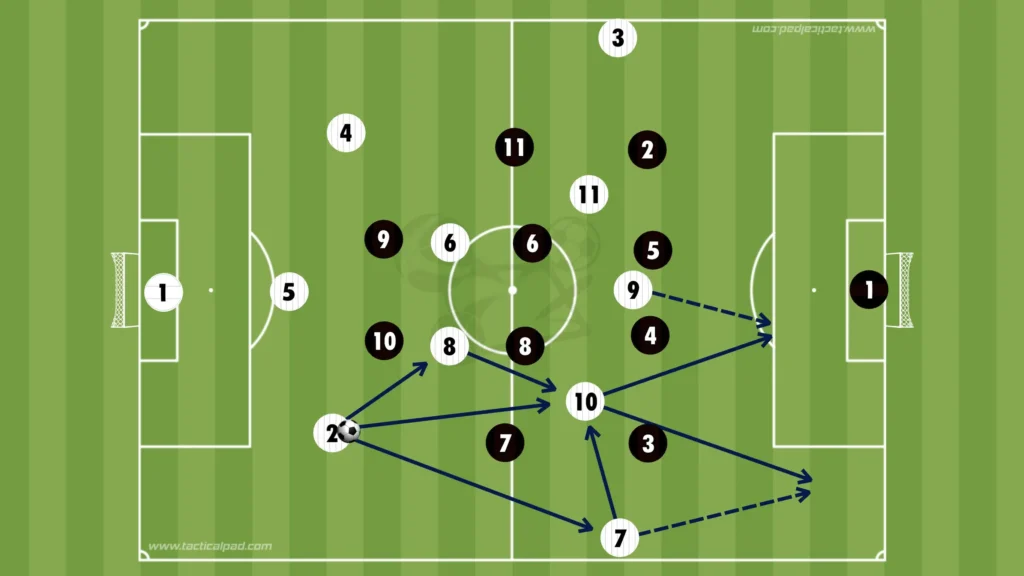
In modern La Liga, attacking through the central channels is no longer just about having a talented number 10 drifting between the lines. It is the product of coordinated structures that move the ball from the defensive third into central pockets, compress opponents, and then accelerate into the final third through vertical combinations. Understanding how teams use those middle corridors reveals why some sides create consistent danger through the centre while others are repeatedly forced toward lower-value wide deliveries.
Why Central Channels Still Matter in a League Obsessed With Compactness
La Liga teams increasingly prioritize compact, narrow defensive blocks intended to shut off the middle of the pitch. Coaches build mid-blocks that squeeze central lanes, trying to deny progressive passes and force opponents toward the flanks where they can be more easily contained. In that environment, any side that still generates clean central progression has clearly solved a tactical puzzle that many opponents are actively trying to set.
Central attacks matter because they typically lead to higher-quality chances than speculative wide crosses or long shots. Research on offensive sequences in La Liga shows that possessions ending in the attacking third or with shots are often built through structured, vertically oriented progressions rather than random long balls. When those progressions run through the middle, they tend to produce better shooting locations, more dangerous final passes, and more complex decisions for defenders protecting the box.
How La Liga Teams Structure Build-Up Through the Middle
Teams that attack centrally usually start by engineering superiority around the first and second lines of build-up. Centre-backs and defensive midfielders have become more involved in circulation, increasing their volume of passes into the middle and final thirds as they step into playmaking roles. By pulling opponents toward the ball and layering support around central midfielders, these teams create angles to split lines rather than merely recycling possession.
Once the first line is broken, attacking midfielders and wingers often move closer to central zones during build-up, shortening passing distances and enabling quick, one- and two-touch combinations. This vertical compactness allows the ball to travel through the centre in short bursts, with several potential receivers available between lines and in the half-spaces, which keeps defenders guessing about who will initiate the decisive action.
Mechanisms of Central Penetration Versus Direct Vertical Attacks
There is a crucial distinction between controlled central progression and purely direct vertical attacks. Studies comparing direct attacks and more combinative patterns across La Liga and other leagues show that direct long balls can penetrate low blocks but are relatively inefficient at generating high-quality goal scoring opportunities. Many of these actions rely on long, often aerial passes from deeper zones into crowded areas, where the margin for error on both the pass and first touch is small.
By contrast, combinative central attacks in La Liga focus on shorter vertical progressions through one channel, using reduced width and carefully timed support around the ball to move forward without excessive lateral circulation. These sequences seek to break lines with passes into advanced midfielders or strikers dropping between defenders, allowing for lay-offs, third-man runs, and through balls that arrive in better finishing zones than those produced by hopeful direct play.
Comparing Controlled Central Build-Up and Direct Central Attacks
Controlled central build-up and direct vertical attacks both travel through the middle, but they differ in tempo, risk, and support structures. Controlled sequences emphasize secure progression and sustained occupation of central pockets, while direct attacks prioritize speed and surprise with fewer intermediate passes. In La Liga, evidence suggests that vertical progression remains the key dimension for penetration, yet the way that progression is achieved strongly influences the frequency and quality of resulting chances.
Direct long balls from deep can be valuable against compact, low blocks when timing and aerial quality are high, but their low conversion into clear goal scoring opportunities limits their reliability as a main attacking method. Structured central combinations, on the other hand, require more technical coherence and coordinated movement but offer more repeatable routes into high-value zones in and around the penalty area, especially for teams with creative central midfielders.
Team Archetypes: Who Really Attacks Through the Middle?
Not every La Liga team uses central corridors in the same way, even if league-wide trends show increased emphasis on structured build-up and vertical progression. Some sides, including leading clubs, rank highly in successful passes into the middle and final thirds, reflecting a preference for central circulation and combinations. Others still rely more heavily on wide progressions, with central midfielders acting as distributors into the flanks rather than as direct penetrators through the centre.
A simplified categorization helps frame the different tactical identities and how they impact central attacking patterns:
| Team archetype | Central usage pattern | Typical outcome on attacks |
| Possession-heavy central combinator | High volume of middle-third and final-third passes | Frequent entries between lines and cutbacks into box |
| Flexible central–wide hybrid | Balanced use of middle and flanks | Varied attacks; central use spikes against deeper blocks |
| Wide-oriented progression side | Central players as switch distributors | Many attacks end in lateral passes and crosses |
| Direct vertical channel attacker | Fast, long central balls from deep | Intermittent penetration; low overall GSO efficiency |
Thinking in these archetypes clarifies that “attacking through the middle” can either be a deliberate, possession-based identity or a by-product of direct, high-risk football. The most consistently dangerous La Liga teams in central zones usually fall into the first two categories, where midfield structure and positional play give forwards repeated access to high-quality central spaces.
Tactical Trends Shaping Central Attacks in Modern La Liga
Recent analyses of La Liga’s tactical evolution highlight a league-wide shift toward more organized defensive structures and nuanced build-up patterns. Teams increasingly defend with narrow mid-blocks aimed at protecting central corridors and controlling half-spaces, forcing opponents to be more creative in how they access interior channels. This defensive compactness reduces the value of simple, predictable central passes and raises the importance of positional rotation and vertical compactness when constructing attacks.
Offensively, coaches experiment with different ways to create three-player first lines in build-up, sometimes pushing full-backs into midfield or asking holding midfielders to drop deeper to manipulate pressure. The goal is to generate numerical superiority around the ball while preserving multiple progression routes, so that when central channels do open, teams can immediately exploit them with quick combinations rather than slow, telegraphed passes. These trends collectively make central attacking a higher-skill, higher-organization task than in previous eras, even if the fundamental rewards—better shots and more dangerous passes—remain the same.
Reading Central Attacks From a Data-Driven Betting Angle (UFABET Paragraph)
When central attacking patterns are viewed through a betting lens, they become a way to explain why certain teams generate particular profiles in metrics such as expected goals, shot quality, and shot locations rather than just raw shot counts. In a data-rich sports betting service that surfaces granular stats on where attacks originate and how possessions progress, bettors can differentiate between sides whose numbers come from dangerous central combinations and those whose output is inflated by lower-value wide play. Within that analytical context, someone using ufabet168 member to study La Liga might treat central progression data—successful passes into the middle third and final third, key passes from central zones, and through-ball frequency—as inputs to judge whether totals markets, team goal lines, or player props align with a club’s actual ability to break compact blocks through the centre, rather than just assuming that all possession-based teams create chances in the same way regardless of where their attacks flow.
Where Central Attacking Structures Break Down
Even well-crafted central systems fail when execution or context undermines the underlying principles. High compactness can easily turn into overcrowding, where too many players occupy similar spaces and block passing lanes, making it easier for defenders to intercept or force turnovers. When central midfielders receive under pressure without clear options, attacks through the middle slow down and become predictable, inviting counter-attacks once possession is lost.
Opponents can also deliberately target central buildup by using pressing traps that lure passes into specific zones before collapsing around the receiver. In those situations, teams that insist on forcing central progressions without adjusting tempo or width can suffer dangerous losses in transitional moments. Over time, this can push coaching staffs toward hybrid approaches that mix central combinations with switches of play and occasional direct balls to avoid becoming tactically transparent.
How casino online Environments Can Distort the Perception of Central Play
In digital gambling contexts, the presentation of statistics and highlights can unintentionally skew how people think about central attacking. A casino online website that emphasizes shot totals or goal reels without distinguishing between central and wide origins might lead users to treat all attacking volume as equally sustainable. That framing can obscure the fact that La Liga teams generating chances through well-structured central corridors may have more repeatable offensive patterns than sides relying heavily on speculative crosses or long shots, even if headline metrics look similar.
To maintain a grounded view, analytically minded bettors need to probe beneath surface numbers, checking how often dangerous passes and shots come from central zones and whether those patterns persist across different types of opponents. This involves treating location-based data—central key passes, through balls, and middle-third progressions—as separate signals that indicate tactical capacity rather than just random variation. In doing so, they can better judge whether a team’s apparent attacking strength is built on a resilient central framework or on less reliable sources of chance creation that might fade under tighter defensive setups.
Summary
Central attacking in La Liga is shaped by the tension between teams striving for vertical combinations through the middle and opponents determined to protect those corridors with compact, organized blocks. Sides that successfully exploit the central channels use structured build-up, vertical compactness, and coordinated movement to turn middle-third progression into high-quality final-third actions, often reflected in advanced passing and attacking-threat metrics. Yet these structures remain vulnerable to pressing traps, overcrowding, and tactical evolution, which means central attacks are best understood not as a fixed stylistic label but as a dynamic set of solutions that must constantly adapt to changing defensive trends and competitive contexts across the league.
